
Every roll-up starts with the same math: buy companies at about 5x EBITDA and sell the combined group at about 10x.1 The multiple gap alone is not enough, though. In a study of 44 roll-ups, deals that relied only on the gap returned 1.4 times the money invested, while deals that also grew sales or improved margins returned 2.2 times.2
Procurement is one of the fastest ways to improve margins. A platform with 15 add-ons starts with 16 sets of supplier contracts, 16 price lists and 16 ways of buying. When the group combines that spending, it earns better prices and terms. When it does not, money leaks out through missed discounts, duplicate vendors and rising prices.
Below, we show why a larger group should buy for less, where roll-ups lose money on buying, and what owners can do at each stage of ownership.
The math
Why a bigger group should buy for less
When a roll-up combines its buying, scale should lower costs in four ways:
- Economies of scale. Combined orders earn volume discounts and rebates.
- Focus on strategic suppliers. Concentrating spend with a few strategic suppliers gives the group more leverage and costs less to manage than 16 separate vendors.
- Stronger negotiating. A larger buyer can work out what an item should cost and make suppliers justify their prices.
- Shared category expertise. Buyers who know a category well, such as fleet, IT or materials, can apply that knowledge across every site.
None of this happens on its own. Each add-on arrives with its own suppliers and habits. Scale lowers costs only when the group combines its buying.
The payoff is large because buyers price the group as a multiple of EBITDA. At 10x EBITDA, every $1 million the group saves each year adds about $10 million to its sale value. Every $1 million it wastes removes about $10 million.
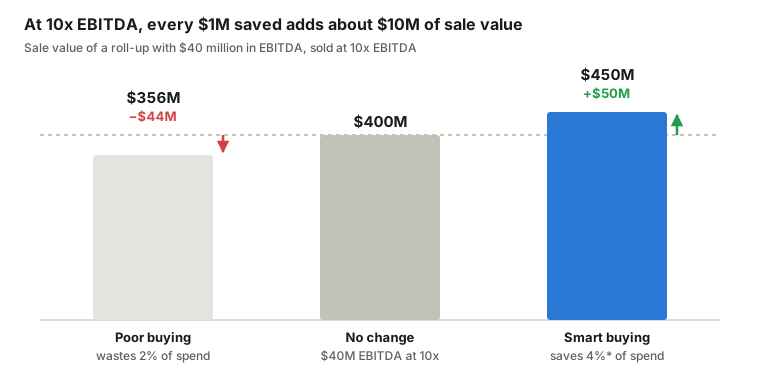
Take a group with $40 million of EBITDA that sells at 10x, for $400 million. It spends $125 million a year with suppliers.
- Smart buying: Saving 4 percent of supplier spend adds $5 million of EBITDA. At 10x, value rises by $50 million.
- Poor buying: Wasting 2 percent of supplier spend cuts EBITDA by $2.5 million, which lowers value by $25 million at 10x. If the buyer also pays a lower multiple because the companies never truly combined, say 9.5x instead of 10x, value falls by about $44 million in total.
The evidence
Why procurement savings are reliable
Supplier spending makes up a substantial share of costs in most roll-ups, so even small savings move EBITDA. How large that share is depends on the industry.
Procurement accounts for 25 to 40 percent of the possible cost savings in a typical merger. Companies that hit their procurement targets are also much more likely to succeed overall.4 Roll-ups get the same chance with every add-on.
Procurement savings also arrive fast. In one merger, the companies aligned their buying policies before the deal closed and captured savings of about 10 percent of spending six months early. Cutting waste, such as unused software licenses or duplicate services, could deliver about half the possible savings on indirect items such as travel, IT and marketing.5 For a firm that plans to sell in about five years, six extra months of savings matters.
There are six main ways to save. Some are quick and small; others are slow and large:
| Way to save | What it means in a roll-up | Size | Speed |
|---|---|---|---|
| Match the best price | Move every add-on to the best price any site already pays | Small; few items match exactly | Weeks |
| Combine buying power | Pool orders to earn bigger discounts and rebates | Large for indirect items; one merger cut marketing agency costs almost 10% | Months |
| Know the real cost | Work out what an item should cost and negotiate from that | One of the largest | Months |
| Use the same standards | One travel policy, one truck spec, one packaging standard | Medium to large | Months |
| Cut waste | Drop unused or duplicate purchases so money goes where it matters | Large; could reach half of indirect savings in one case | Weeks to months |
| Make instead of buy | Bring in-house what the larger group can now afford to do itself | Large but hard | Quarters |
The middle rows usually hold the biggest wins. Matching prices is an easy first step, but buying power pays off only when add-ons actually buy through group contracts.
Beyond price
Five habits that make savings last
Better prices are only the start. Savings last when the group also changes how it tracks, chooses and buys what it needs.
1See all spending in one place
You cannot manage what you cannot see. After a few acquisitions, spending data sits in different accounting systems, under different supplier names and category labels. The group needs one clean view of who it buys from, what it buys, what it pays and under which contract. Procurement leaders agree: in a 2025 survey of more than 250 chief procurement officers, 72 percent named cost cutting to protect margins as a top priority, and 67 percent named digital tools and AI.6 Both depend on clean spending data.
2Buy fewer kinds of things
Each add-on brings its own versions of the same items, such as different gloves, filter brands, uniforms or software plans. Every extra version, or SKU, splits volume across more suppliers and weakens buying power. Fewer SKUs let the group buy more of each item at better prices and manage stock more easily. One European heavy equipment maker standardized parts across its product lines and cut costs 12 percent in six months.7 Simplifying works best when the people who use the items help pick the standard.
3Treat key suppliers as partners
Squeezing suppliers on price works once. Working with them pays off year after year. In a survey of more than 100 large companies, those that regularly collaborated with suppliers grew faster, ran at lower cost and earned higher profits than their peers.8 In a roll-up, pick a few strategic suppliers, share growth plans and volume forecasts, agree on targets for cost, quality and delivery, and share the gains. A supplier that knows the group will keep adding sites has a reason to serve it well.
4Run buying on one set of tools and steps
Savings leak when people buy from anyone, any way they like. A simple shared workflow stops the leak. Employees request what they need. The system points them to approved suppliers and contract prices. A purchase order goes out, and finance checks each invoice against the order before paying. Good tools also free buyers from manual data work. Top procurement teams turn requests into purchase orders 58 percent faster than peers, lose 60 percent less savings to off-contract buying, and give analysts 26 percent more time for analysis.9 Speed and control can go together.
5Don't ignore the long tail
Most groups also buy from a long list of small suppliers. Each is minor, but together they add up, and few people watch them. Off-contract buying in this tail erases savings: such “maverick” spending costs companies 10 to 20 percent of their targeted savings.10 Steering small purchases to a short list of approved suppliers, catalogs or company cards keeps the tail in check without slowing anyone down.
The risks
How roll-ups lose money on buying
Roll-ups rarely fail all at once. Between 30 and 40 percent fall short of expectations because of messy integration, lower sale prices or operational problems.1 Buying problems are the hardest to spot, because each loss is small and spread across many companies. Six problems come up often.
1. Orders stay split. Each add-on keeps its own supplier account. No supplier sees the group's total volume, so the group never reaches the top discount tiers. It buys like 16 small customers instead of one large one.
2. Supplier deals get reset. Ownership changes often bring slow changes to supplier deals. One regional tire chain lost the rebates it had earned with parts supplier Worldpac after Worldpac was sold in 2024; the supplier moved the chain to a standard program. Such changes usually appear in the second year after a deal.11 Roll-ups face the same risk. Deals a founder made personally may end after the sale, so someone must own the job of moving every site to the best price.
3. Vendors and systems pile up. Every add-on brings its own software, insurance broker, truck leases and IT providers. Buying teams then pull data from several finance systems just to see which suppliers their sites share. Without that full picture, no one can measure savings, let alone capture them.
4. Unfinished work builds up. Teams usually feel the strain around the third add-on, when leftover work from earlier deals makes the next one harder than planned.12 Buying often slips first, because suppliers keep shipping and nothing looks broken. Roll-ups go wrong when owners chase cheap deals but skip the work of combining the companies.13
5. Savings fail the sale-time check. At sale time, the buyer checks whether promised savings show up in EBITDA. Savings that exist only on paper fade as sites drift back to old vendors. When the buyer's accountants spot this, they discount the savings and may question the price.
6. Consolidating without testing the market. Fewer suppliers pay off only if they are the right ones. It is tempting to move every site to the platform's existing vendor without checking whether other suppliers offer better price, quality or service. Run a competitive process first, so the group puts its volume with the best suppliers, not just the most familiar ones.
Each of these problems looks small on its own. Together, they decide whether the group's scale shows up in EBITDA.
Making it stick
Owners, incentives and cash
Savings plans usually fail for lack of an owner, not lack of ideas. Four choices make the difference.
- Put someone in charge at the platform. Most add-ons are too small to have their own buying team. A buying lead or shared team at the platform should own the spending data, the contracts and each new add-on's onboarding.
- Use group purchasing programs with care. Many private equity firms offer buying programs across their portfolio or partner with group purchasing organizations that have ready-made contracts. These can help with common items such as phone plans and office supplies. But they pay off only when the group knows what it buys today and at what price. Without that view, a site can switch to a program price that is worse than its current deal. Check each program against your own spending data before moving to it.
- Agree with finance on what counts as savings. Measure each saving against what was paid before, using past invoices and old contract prices as the baseline. A new contract at 8 percent below last year's price is a real saving that raises EBITDA. Have the CFO sign off on how savings are counted, so reported savings match the accounts.
- Align payment terms across add-ons. Payment terms set how many days the group has to pay a supplier's invoice. If one add-on pays in 15 days while the group standard is 60, moving it to 60 days keeps that cash in the business longer, money the group can use to pay down debt or fund the next deal. Check that longer terms do not come with higher prices.
The plan
A plan for the whole ownership period
Treat buying as ongoing work from before the deal to the sale. Include procurement in diligence, so the value creation plan starts with a realistic view of savings. After close, bring each new company into group buying as it joins.
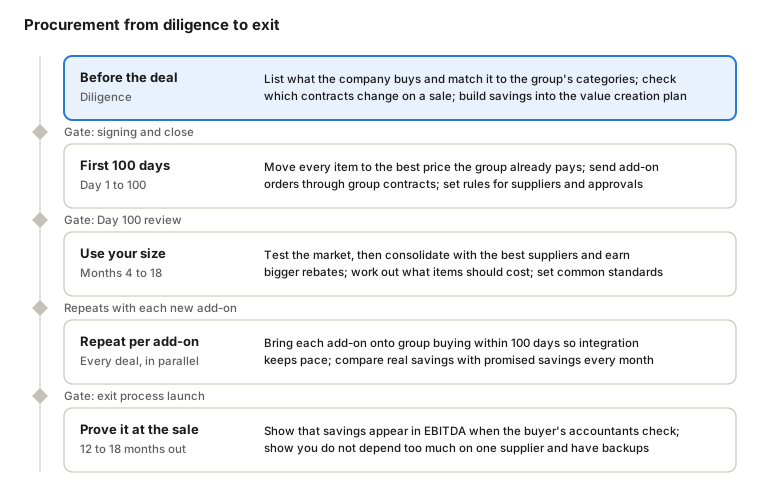
Timing matters: at exit, the buyer values the platform on its last twelve months of EBITDA, so savings captured early count in full, while late savings may be discounted. Starting early turns procurement from a promise into proof.
Scorecard
What to track
Operating partners should add these buying measures to the board report. They show whether scale is turning into EBITDA.
| Measure | What it tells the board | Warning sign |
|---|---|---|
| Share of add-ons in group spending data | Whether the group can see every company's spending | An add-on still missing 100 days after the deal |
| Spending through group contracts | Whether add-ons actually buy at group prices | Flat or falling as add-ons join |
| Suppliers per $1 million of spending | Whether the group is consolidating its suppliers | Not falling once add-ons are integrated |
| Rebates earned versus available | Whether the group collects every discount it qualifies for | Combined volume crosses a discount tier, but no one claims the rebate |
| Price differences on common items | Whether every site pays the best group price | Same item, different prices at different sites |
| Payment terms versus group standard | Whether add-ons follow group payment terms | Add-ons paying suppliers sooner than the group standard |
| Service levels after a supplier switch | Whether combining suppliers hurts delivery or quality | More late deliveries, back-orders or complaints |
| Savings in the accounts versus savings promised | Whether savings reach EBITDA | Promised savings growing faster than real ones |
| Biggest supplier's share of spending | Whether the group depends too much on one supplier | One supplier above an agreed share with no tested backup |
When the PE firm sells the platform, the next buyer looks hardest at two things: savings that show up in the accounts, and whether the group relies too much on one supplier.
Sources
- Private Equity Roll-Up Strategy: 2026 Complete Guide, CT Acquisitions, updated 2026
- Building a Stronger Buy-and-Build, Bain & Company Global Private Equity Report, March 2024
- Strategic spend management: best-in-class strategies for CPO success, Ardent Partners, 2017
- Procurement-driven synergies in mergers: Landmine or goldmine?, McKinsey & Company, August 2017
- Get more procurement value from M&A, even before closing, McKinsey & Company
- Global Chief Procurement Officer Survey 2025, Deloitte
- Cleansheet: our impact, McKinsey & Company
- Taking supplier collaboration to the next level, McKinsey & Company, July 2020
- Digital World Class procurement teams achieve 2.6X higher ROI, The Hackett Group, July 2025
- Perception vs Reality: A Report on Maverick Spend, The Hackett Group for Basware
- When your parts supplier changes hands, Giorgio Andonian, Aftermarket Business World, May 2026
- The buy-and-build trap: why add-on integration fails more than GPs admit, V7 Labs
- How private equity is using M&A integrations to overcome headwinds, McKinsey & Company